

3D Jewelry Design: The Complete Guide
What 3D jewelry design really means
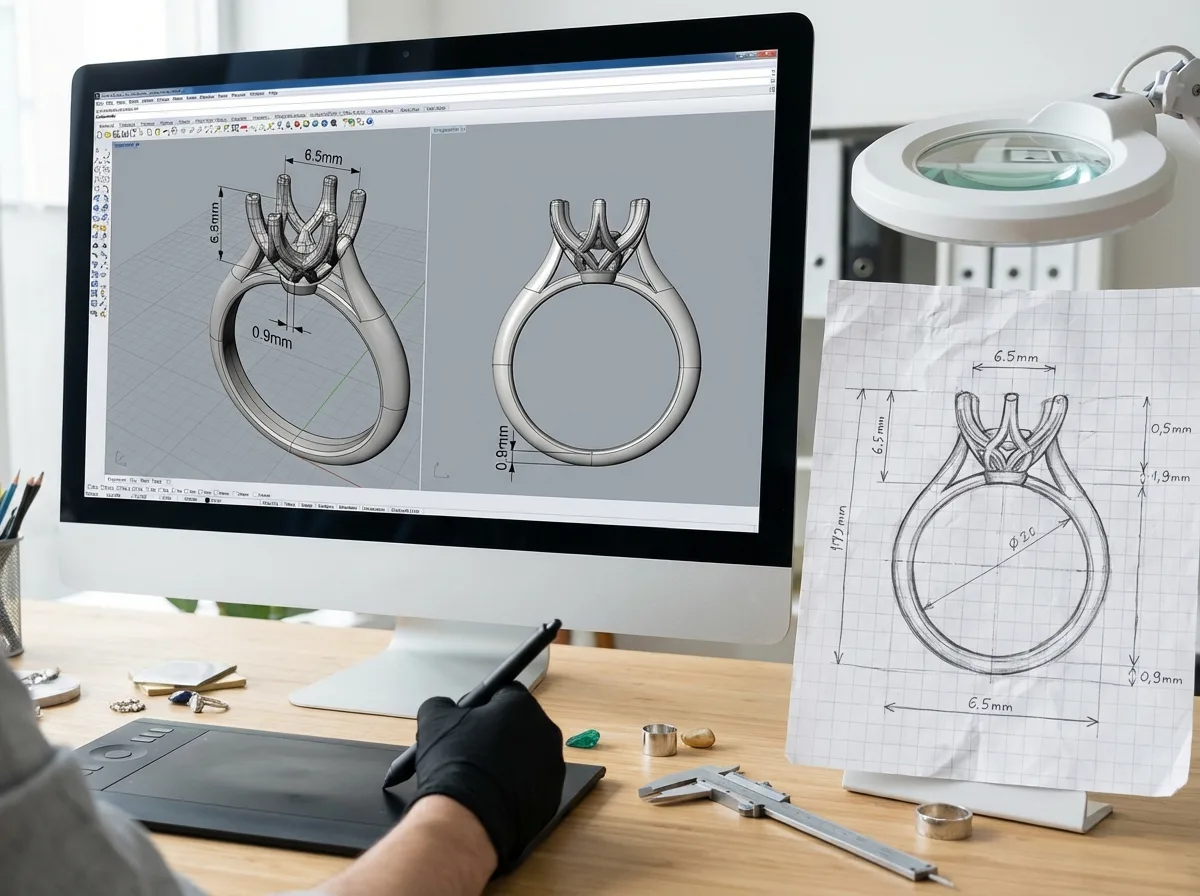
At its core, 3d jewelry design is the process of building a jewelry piece as a precise digital model. That model is not just a pretty rendering. It contains measurements, thicknesses, stone seats, prong placement, and structural information that affect how the piece will be produced and worn.
People sometimes confuse digital jewelry design with illustration. They are related, but they are not the same. A hand sketch or design board communicates style and feeling. A 3D CAD model communicates buildability.
From concept art to technical model
Think of it this way. A sketch tells the story. The CAD file tells the workshop what to do. If you are new to this area, it helps to understand the difference between creative concepting and 3d jewelry modeling, where the design becomes measurable and production-ready.
This matters most when your collection includes stone settings, moving parts, hollow forms, engravings, or repeatable styles in multiple sizes. The more technical the design, the more valuable a solid digital model becomes.
What a good digital model includes
- Accurate dimensions and scale
- Metal thickness appropriate for the design
- Stone sizes and setting geometry
- Clasp, hinge, or assembly details where needed
- Allowance for polishing, plating, and casting behavior
What many people overlook is that a beautiful render can still be a poor manufacturing file. A strong 3d jewelry design balances aesthetics with technical logic.
How the digital jewelry design workflow works
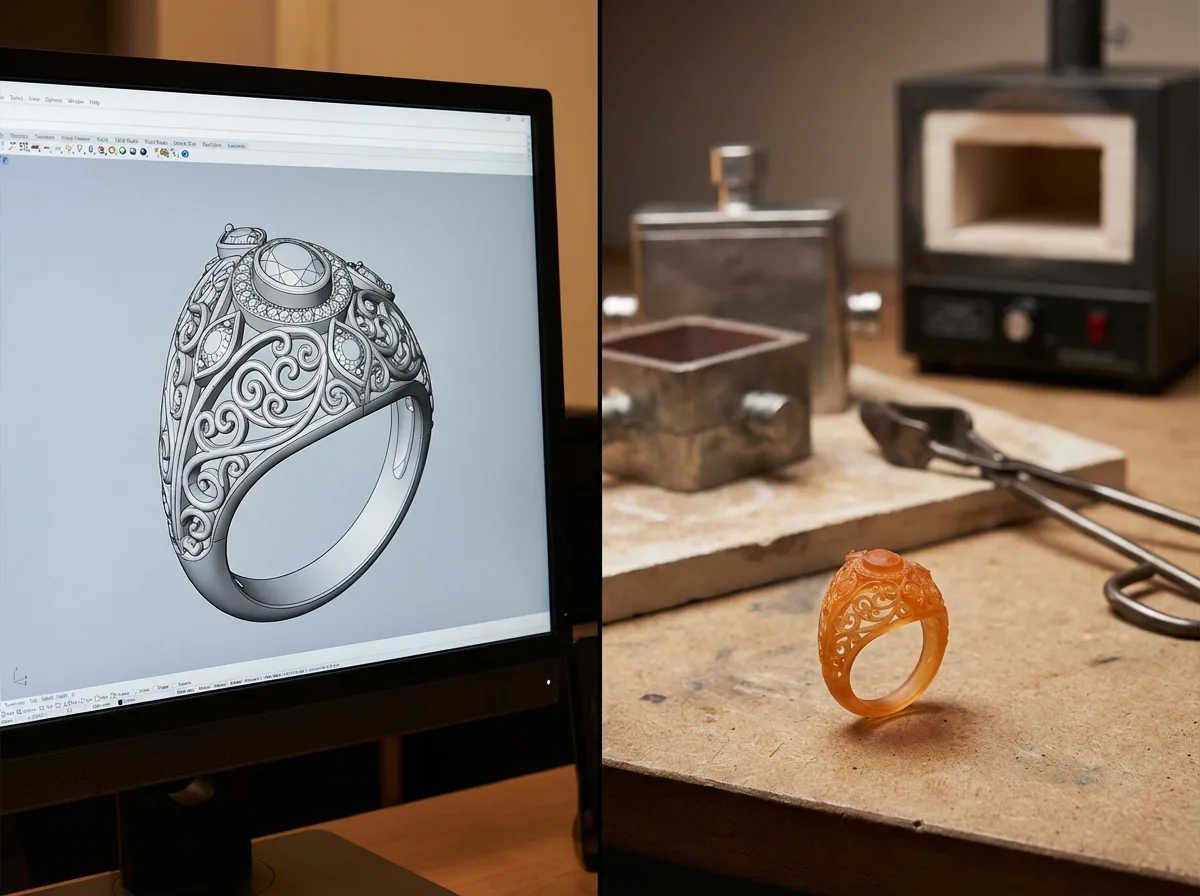
Most successful projects move through a clear sequence. The exact steps vary by factory and by complexity, but the logic stays consistent.
Step 1: Brief and design intent
You begin with a concept. That might include sketches, reference images, competitor inspiration, target retail price, metal preference, stone type, and size range. The better the brief, the smoother the process.
If you are building a signature collection, this early stage should also define your brand identity. Articles like crafting crown jewels guide bespoke jewelry design manufacturing brands are useful because they connect design decisions with brand positioning, not just visuals.
Step 2: CAD development
A designer creates the 3D model using specialized software. During this stage, the team checks dimensions, stone fit, wall thickness, and overall proportions. If the piece is intended for mass production, the model also needs to consider mold performance and assembly efficiency.
Step 3: Rendering and review
Once the file is built, you may receive renders or turntable views to review. This is where you assess silhouette, stone layout, balance, and branding details. Now, when it comes to revisions, it is far less expensive to change a digital file than a finished metal sample.
Step 4: Prototype or resin sample
After approval, the CAD file can be used for prototyping. Many brands choose resin or wax sampling before final metal production. If you want a more detailed look at the next step, see how to make 3d jewelry.
Step 5: Production handoff
Finally, the approved file moves into manufacturing. This stage connects digital design to casting, finishing, plating, stone setting, and quality control. That broader sequence is covered in the jewelry manufacturing process concept creation.
Why brands use 3D CAD jewelry design
The reality is simple. Digital workflows help you make better decisions earlier. That saves time, reduces miscommunication, and helps your team forecast costs more accurately.
Better communication with suppliers
If your factory is in another country, CAD becomes a shared language. Measurements, stone sizes, and design intent are easier to explain in a model than in a rough sketch with handwritten notes. This is especially important when you are managing remote development.
Faster revisions and fewer costly surprises
Imagine launching a ring collection and discovering after casting that the shank is too thin, the center stone sits too high, or the underside feels uncomfortable. In digital jewelry design, these issues can often be caught before sampling.
That is one reason many brands study topics like How Use CAD Technology Faster Jewelry Prototyping when building a more efficient development process.
Improved collection planning
3d jewelry design also helps when you are creating families of products. A single design direction can be adapted into earrings, rings, pendants, and charms while keeping proportions consistent. From a practical standpoint, this supports a more cohesive assortment and makes merchandising easier.
Stronger cost control
CAD does not automatically make a design cheaper, but it does make cost drivers easier to spot. Large stone counts, heavy metal use, complex under galleries, and delicate assembly points become visible sooner. That helps you adjust before committing to production.
Common tools, files, and technical requirements
Not every brand needs to master software personally, but you should understand the basics well enough to ask good questions.
Popular software types
Most professional 3d jewelry design software falls into a few categories: jewelry-specific CAD tools, broader industrial 3D modeling programs, and rendering platforms. Some teams also use browser-based tools or a 3d jewelry design app for early concept development, though final production usually requires more robust software.
Typical file formats
- STL for prototyping and printing
- 3DM for editable CAD work in some software environments
- OBJ for rendering and visualization in some cases
- PDF or spec sheets for review and approval notes
If you are sourcing through an OEM or ODM partner, ask which file formats they accept, who owns the editable file, and how revisions are handled. Those questions can prevent confusion later.
Technical checkpoints that matter
Here are the issues that affect manufacturability most often:
- Minimum and maximum metal thickness
- Stone seat depth and tolerance
- Prong strength and spacing
- Shrinkage allowance for casting
- Surface areas that are difficult to polish
- Hidden cavities that trap investment or debris
What many people overlook is that digital perfection on a screen does not cancel out physical limits. Metal still flows a certain way. Stones still need secure seats. Hands still need access for setting and finishing.
How 3D design connects to manufacturing
This is where many brand owners gain the biggest advantage. A digital model is not the end product. It is a decision-making tool that should make manufacturing smoother and more predictable.
From CAD to sample
Once the file is approved, it may be printed in resin or wax for review, molding, or casting preparation. If the sample reveals issues, the CAD file can be updated and reprinted. That loop is one of the biggest strengths of digital development.
For brands comparing partners, it helps to understand whether the supplier manages only design or also supports prototyping, sampling, casting, finishing, and packaging. Royi Sal Jewelry, for example, presents this as part of a broader Customer Journey, which is useful if you are evaluating end-to-end workflows.
Designing for casting and finishing
A piece that looks elegant in a render may be frustrating in production if the inside corners cannot be polished, the prongs are too fragile, or the channels are too tight for setting. Good 3d cad jewelry design anticipates these issues.
That is why experienced teams review CAD files with manufacturing in mind, not just aesthetics. If your design partner and production partner are disconnected, you can end up approving files that need major changes later.
Quality and repeatability
When your designs move into larger production runs, consistency matters. Standardized digital files make it easier to reproduce core styles with the same stone layout, dimensions, and look. This is especially important for brands scaling from test orders into repeat wholesale production.
If you want to explore how one factory approaches that bridge between file and sample, Royi Sals 3D Sampling Workflow offers a useful example of how digital review can support smoother development.
Mistakes to avoid in custom jewelry design
Here is the thing. Most problems in 3d jewelry design are not caused by software. They come from unclear briefs, unrealistic expectations, or weak technical review.
Approving a render too quickly
A photorealistic image can make a design feel finished even when the engineering is not. Always review measurements, profile views, back views, and stone specifications. Ask how the piece will be cast, set, assembled, and polished.
Ignoring target price point
If your target retail range is tight, the CAD stage should reflect that. Heavy metal weight, large stones, and complex parts all affect cost. Design without cost awareness often leads to painful revisions later.
Overcomplicating your first collection
New brands sometimes try to prove creativity by combining hinges, pavé, engraving, asymmetry, mixed materials, and multiple platings in one launch. That can create sampling delays and QC headaches. Start with pieces that express your brand clearly and can be produced consistently.
Not asking who owns the files
If you are paying for custom jewelry design, clarify file ownership, revision limits, and NDA protection up front. This is especially important if you may move from prototype to volume production later.
How to choose the right partner and process
Whether you use freelance designers, an in-house team, or an OEM manufacturer, your process should match your business stage.
For startups and emerging brands
You may need more support translating ideas into technical files. In that case, look for a partner that can guide concept refinement, CAD development, sampling, and production planning together. Explore their Services and ask how they handle revisions, sampling, QC, and communication.
For established brands scaling collections
You may already have creative direction but need stronger repeatability, faster sampling, or multi-style development. In this case, evaluate capacity, production knowledge, and whether the supplier can maintain consistency across sizes and variants.
Questions worth asking
- Can you review sketches and suggest technical improvements?
- What file types do you create and share?
- How many revision rounds are typical?
- Do you support resin or wax sampling before metal production?
- How do you protect custom designs and confidential files?
- Who checks manufacturability before approval?
A capable partner should be honest when a design needs adjustment. The best manufacturing relationships are not about saying yes to everything. They are about helping you make smarter design decisions before time and money are committed.
When 3D jewelry design is the right choice, and when it is not
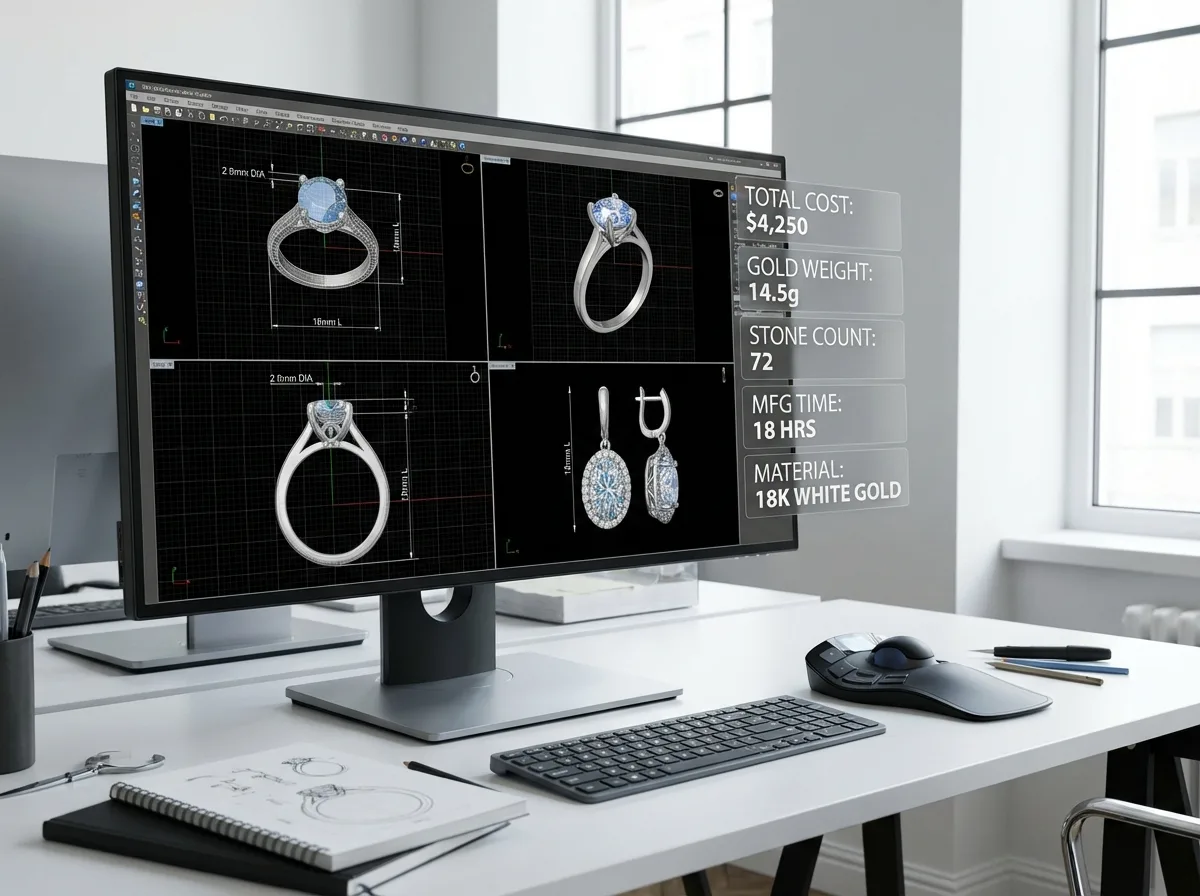
Not every project needs the same level of digital development. In many cases, 3d jewelry design is the right choice because it reduces uncertainty before you spend money on samples, molds, or production. That is especially true for pieces with precise stone layouts, repeated size ranges, matched sets, or technical details that need clean measurements.
Best use cases for digital development
From a practical standpoint, CAD is especially useful when you are launching a new collection, adapting one design into multiple SKUs, or trying to hit a specific target cost. It also helps when your production partner is remote and your team needs a clearer approval process. For private label and wholesale development, that extra clarity can prevent small file errors from becoming larger production problems.
When manual methods may still matter
The reality is that not every design starts best in CAD. Some highly organic surfaces, hand-built textures, or artisan-led forms may begin as wax carving or physical model making first. In those cases, digital tools may still enter later for refinement, sizing, or production adjustments, but they are not always the starting point.
What many people overlook is that digital design and traditional craftsmanship are not competing systems. They usually work best together. A strong process recognizes when precision is needed early and when hand skills should guide the aesthetic direction first.
How 3D printing fits into the design process
People often group 3d jewelry design and 3D printing together, but they are not identical steps. The digital file comes first. Printing is one of the ways that file becomes something physical your team can evaluate.
Why printing helps before production
A printed resin or wax model can help you check scale, silhouette, finger coverage, and the overall feel of a piece before committing to metal. This is useful for rings, statement earrings, layered pendants, and styles where comfort matters as much as appearance. For certain projects, a physical model also makes internal approvals easier because stakeholders can review proportion in real space, not just on a screen.
Printing is a checkpoint, not a guarantee
Here is the thing. A printed model is still part of the review process. It can show shape and proportion clearly, but it does not fully replicate final metal behavior, plating appearance, or stone-setting performance. You still need manufacturing review, sample evaluation, and QC standards that match your product category.
Now, when it comes to direct casting from printed patterns, this can support efficient development for many styles. But success still depends on design logic, print quality, casting control, and finishing access. The file, the printer output, and the workshop process all need to work together.
Design review checklist before sampling
Before you approve a CAD file for sampling, it helps to slow down and review the piece from a manufacturing point of view. This step sounds simple, but it is where many expensive mistakes can still be prevented.
Questions to confirm before approval
- Does the design meet your target size, weight, and price direction?
- Are all stone sizes, counts, and setting types confirmed?
- Have side and back views been reviewed, not just the hero angle?
- Are thin areas, sharp edges, and comfort points acceptable for wear?
- Can the piece be polished, assembled, plated, and set without unnecessary risk?
- If the design comes in multiple sizes, have proportions been checked across the range?
What to align with your manufacturer
Consider this. Approval should not only mean that the piece looks good. It should also mean your team and your manufacturer agree on what will be made. Confirm tolerances, finishing expectations, plating color, logo placement, and any packaging-sensitive dimensions before the sample stage begins.
The more alignment you create here, the more useful your first sample becomes. That does not guarantee zero revisions, but it usually leads to faster decisions and fewer avoidable changes.
Frequently Asked Questions
What is 3d jewelry design used for?
3d jewelry design is used to turn a concept into a precise digital model that can be reviewed, revised, prototyped, and manufactured. It helps brands visualize proportions, stone placement, thickness, and wearability before committing to samples or production. For B2B projects, it is especially useful because it creates a shared technical reference between your team and the factory. That reduces misunderstandings and gives you a clearer path from concept to finished piece.
Is 3D jewelry design only for large brands?
No. Small brands often benefit even more because early mistakes are more expensive when your budget is tight. A strong digital model can help you avoid unnecessary sample revisions and better understand what your design will cost to produce. If you are launching your first line, digital jewelry design can help you refine your collection before investing heavily in tooling, casting, or inventory. It is a practical tool, not just a luxury process for big companies.
What is the difference between CAD and 3D jewelry modeling?
People use the terms interchangeably, but there is a slight distinction. CAD usually refers to computer-aided design in a technical sense, including measurements and production logic. 3D jewelry modeling can refer more broadly to building the digital form itself. In practice, for jewelry manufacturing, you usually need both the visual model and the technical accuracy. That is why production-ready files are more valuable than decorative digital renders alone.
Can I start from a sketch or photo reference?
Yes, and many projects do. A sketch, inspiration board, or reference piece can be enough to begin if your design partner knows how to translate it into a technical file. The better your references, the easier that process becomes. Include dimensions, target metal, stone types, clasp preferences, and your intended market position if possible. Even a rough idea can become workable, but clarity at the beginning usually saves time and revisions later.
Does a 3D design guarantee the final sample will be perfect?
No. It improves accuracy, but it does not remove the need for sampling and review. Casting behavior, polishing access, plating finish, stone setting tension, and comfort on the body still need to be tested physically. The reality is that 3D design reduces risk rather than eliminating it. You should still expect a sample evaluation stage, especially for new styles, high stone counts, moving parts, or unusual forms.
What files should I ask for from a jewelry designer or manufacturer?
Ask what they typically provide and what is editable. Common files include STL for printing or prototyping, 3DM in some CAD environments, renders for review, and technical spec sheets. Just as important, confirm who owns the source file and whether additional edits are included. If your project is custom, ask about NDA options and file transfer terms. These details matter if you plan to change suppliers or expand a design into a larger collection later.
How does 3d jewelry design affect cost?
It affects cost in two ways. First, there is the design and development cost itself. Second, and often more important, it helps you spot production costs before manufacturing starts. Heavy metal weight, complex under structures, many small stones, and hard-to-finish areas all increase cost. A good CAD review helps you decide which details are worth keeping and which ones should be simplified. That can protect margins without losing the spirit of your design.
Can 3D jewelry design be used for silver, gold, and brass?
Yes. The same digital approach can be used across sterling silver, gold, brass, and other jewelry metals. What changes is how the design should be engineered for each material. Some forms that work well in one metal may need thickness or setting adjustments in another. This is why manufacturing input matters during the CAD stage. If your collection may later expand across metals, mention that early so the design team can account for those differences.
What should I review before approving a CAD file?
Look beyond the front view. Check dimensions, side and back profiles, thickness, stone sizes, comfort areas, clasp function, logo placement, and any part that will be polished or assembled. Ask whether the design has been reviewed for casting and setting practicality. If your product needs to hit a specific retail range, review estimated weight and major cost drivers at the same time. Approval should be based on function as well as appearance.
Should I work with a standalone designer or a manufacturer that also designs?
That depends on your needs. A standalone designer can be a good choice if you already understand manufacturing requirements and just need creative development. A manufacturer with design capability can be helpful when you want the same team to think about CAD, sample making, and production constraints together. Royi Sal Jewelry is one example of a manufacturer that supports digital development as part of a broader OEM and ODM process, which can simplify communication for some brands.
Can 3D jewelry design handle very intricate details?
Yes, but intricate does not always mean easy to manufacture. Digital tools are excellent for building filigree patterns, geometric layouts, interlocking forms, and fine decorative structures with precise symmetry. What matters is whether those details are still strong enough for casting, finishing, and long-term wear. A good CAD file should make complexity manageable, not just visually impressive.
Is 3D printing the same as 3D jewelry design?
No. 3d jewelry design is the digital modeling stage. 3D printing is one possible output from that file, often used for resin or wax models before casting. They work together, but they are different parts of the workflow. You can have a CAD file without printing immediately, and you can use printing as a checkpoint before final production.
Can digital jewelry design replace hand craftsmanship completely?
No. Digital tools improve precision and planning, but hand craftsmanship still matters in finishing, stone setting, polishing, assembly, and certain artistic techniques. The strongest results usually come from combining accurate digital development with experienced workshop skills. Think of CAD as a way to improve decision-making, not as a replacement for jewelry making expertise.
Key Takeaways
- 3d jewelry design turns concepts into measurable, production-aware digital models.
- Strong CAD workflows reduce miscommunication, speed up revisions, and improve collection planning.
- A beautiful render is not enough. Manufacturability, stone setting, finishing, and cost all need review.
- Sampling still matters, even with excellent digital files.
- The right design partner should guide both aesthetics and production reality.
- 3D printing is a useful checkpoint in development, but it is not the same as design and it does not replace sample evaluation.
- Digital tools and hand craftsmanship work best together, especially for intricate or production-sensitive styles.
Conclusion
3d jewelry design is no longer a niche tool used only by large factories or highly technical design teams. It has become a practical standard for brands that want better control over development, quality, and communication. If you are building a custom collection, refining an existing bestseller, or preparing to scale production, digital workflows help you make smarter decisions before those decisions become expensive.
Here is the real advantage. Good digital jewelry design does not replace creativity. It protects it. It gives your ideas structure, tests them against manufacturing reality, and creates a clearer path from concept to market. When your design files are strong, your sample stage becomes more productive and your production stage becomes more predictable.
If you want to explore how a manufacturing partner can support digital development, prototyping, and production, get in touch with Royi Sal Jewelry.




Responses (0)